David Kessler co-authored two books with Elisabeth Kubler-Ross, Life Lessons and On Grief and Grieving. He wrote himself the book The Needs Of the Dying - A Guide for Bringing Hope, Comfort, and Love to Life's Final Chapter. As Marianne Williamson would describe that "This book serves the needs of the person sitting by the bedside as much as it does the person who is lying in the bed. In it you will find gentleness and peace in the experience of death."
The listed Needs of the Dying is indeed a good checklist for the caretakers as well as those who are dying and who would like to find out what they may be missing in their end stage of life (and therefore to make this stage more rewarding, peaceful and fill with comfort.
* The need to be treated as a living human being.
* The need to maintain a sense of hopefulness, however changing its focus may be.
* The need to be cared for by those who can maintain a sense of hopefulness, however changing this may be.
* The need to express feelings and emotions about death in one's own way.
* The need to participate in decision concerning one's care.
* The need to be cared for by compassionate, sensitive, knowledgeable people.
* The need for continuing medical care, even though the goals may change from "cure" to "comfort"goals.
* The need to have all questions answered honestly and fully.
* The need to seek spirituality.
* The need to be free of physical pain.
* The need to express feelings and emotions about pain in one's own way.
* The need of children to participate in death.
* The need to understand the process of death.
* The need to die in peace and dignity.
* The need not to die alone.
* The need to know what the sanctity of the body will be respected after death.
In the process of writing this book, David visited Elisabeth Kubler-Ross, the pioneer in research of death & dying. When asked if she had any comments or advice regarding the needs and rights of the dying, she said "If we could remember to treat the living well, we wouldn't need to remember the rights of the dying; we would meet their needs naturally."
I cannot agree more! If we know how to treat the living well, both for ourselves as well as the other fellow citizens, we would manage our needs of the dying very well.
+++++ +++++ +++++
Lakers (L.A.) finally won the NBA champion this year from the tight hands of Celtics (Boston). Both teams need to fight up to Game 7 and both are very competitive and playing extremely hard. Even at the end of Session 3, I would have thought Celtics would be the champion, as Lakers were not really doing well. Then, come the last session, and under the pressure of the local audiences, Celtics was kind of giving in and compromised with their performance. Overall it was a very nice game to watch!
Showing posts with label Elisabeth Kubler Ross. Show all posts
18 June, 2010
31 May, 2010
I Don't Know What To Say ... ...!
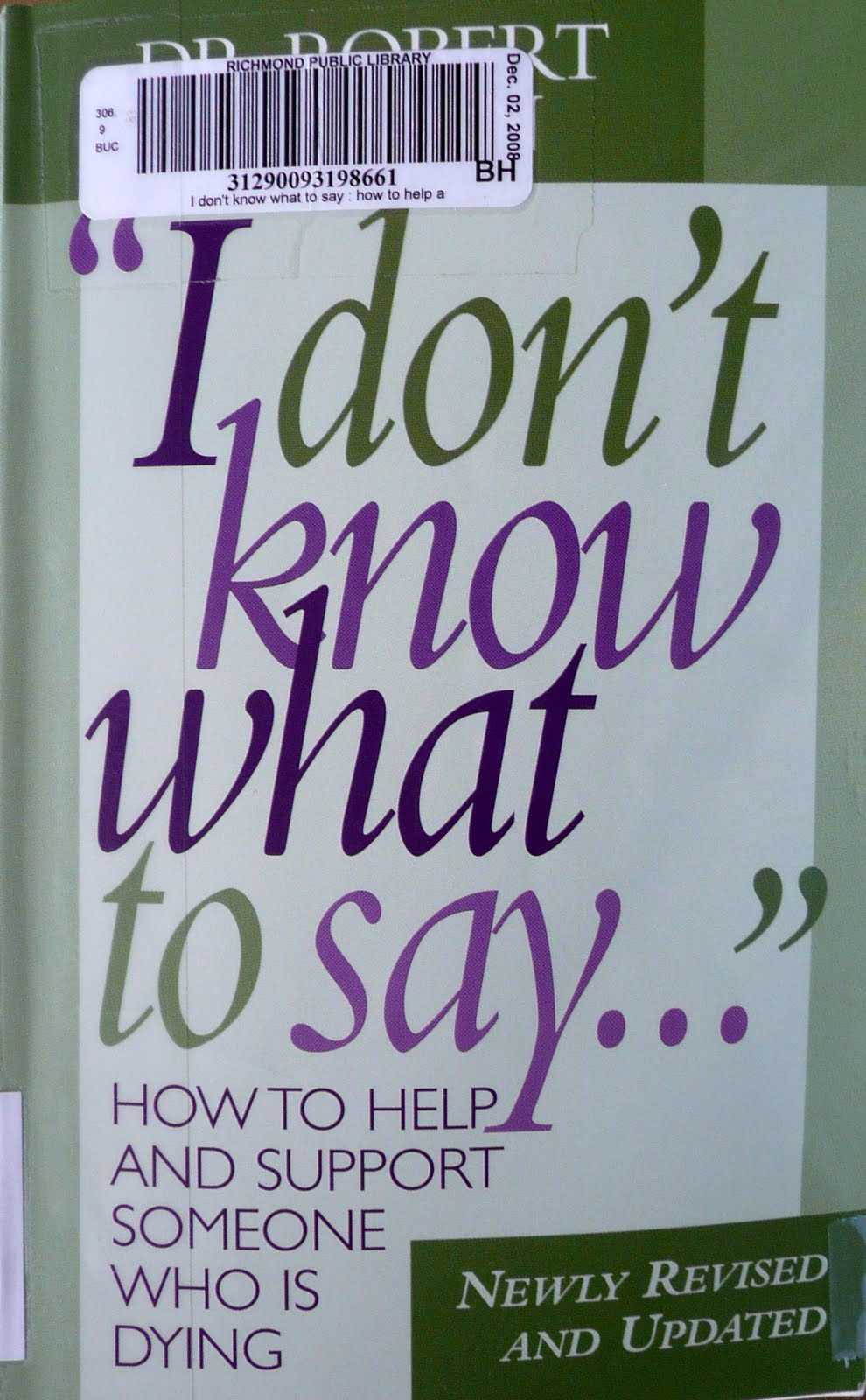
You may not believe that this is actually the title of a book, I Don't Know What To Say ... ... with sub-title of How To Help And Support Someone Who Is Dying. Written by Dr. Robert Buckman, a medical oncologist involved his life with terminally ill people, with contributions by Ms Ruth Gallop, a registered nurse and psychotherapist, and Rev. John Martin who is a hospital chaplain at a cancer center. This book is first published in 1988.
The book is structured into three main sections.
The First Section titled Talking and Listening, with three chapters: 1. Why Talk? Why Listen? 2. Sensitive Listening 3. Why You Need to Know What's Going On
The Second Section titled The Process of Dying, with 6 chapters: 4. The Transition 5. Facing the Threat 6. Being Ill 7. The Last Stage 8. Saying Good-bye: The Function of Grief 9. Spiritual Aspects
The Third Section titled Pacticalities, with 4 chapters: 10 Things Every Caregiver Should Do 11. Individual Relationships 12. AIDS and Dementing Diseases 13. Talking with Health Professionals
The first section is really the foundation of preparing ourselves to deal with the dying process. To start with, we need to be a good listener, a sensitive listener. It is also suggested that we shall get prepare ourselves, to learn what's really going on before we start the communication process. Ignorance sometime can hurt other people, especially those that you actually would like to help.
Then, the second section, it discussed some issues that arose from Elisabeth Kubler-Ross' Dying Process. It specially draw our attention to the fact that "all human beings are capable of experiencing several different emotions at the same time". It also discussed the feelings of the patients: shock and disbelief, fear and anxiety, anger and disappointment, guilt and blame, despair and depression, etc. What's important is how to manage the "the last stage", especially the feelings of the patients and the person who is trying to offer their help. No matter you are the dying one or the living ones but trying to taking care of the dying one, we need to address our own feelings carefully. The struggle of the feelings are not easy, and sometime it's just can go ups and downs, even a few times a day. Trying to take control of one's feeling is important but then it can also create tension both inside and outside. The key is on one's self awareness, i.e. knowing how much you can take and manage, and knowing how to release/relax yourself.
The third section is more on some supplementary topics and offered some practical advise.
There is no guarantee that you know what to say after reading this book, but it at least offered some good food for thoughts. It's indeed not easy to communicate with cancer patients, especially those who is very sensitive and surely difficult to handle. More, it's usually best if they themselves can help themselves in this process, as it's the most effective way of addressing this "end stage of life", or like the scholars suggested "the end stage of growth"!
The book is structured into three main sections.
The First Section titled Talking and Listening, with three chapters: 1. Why Talk? Why Listen? 2. Sensitive Listening 3. Why You Need to Know What's Going On
The Second Section titled The Process of Dying, with 6 chapters: 4. The Transition 5. Facing the Threat 6. Being Ill 7. The Last Stage 8. Saying Good-bye: The Function of Grief 9. Spiritual Aspects
The Third Section titled Pacticalities, with 4 chapters: 10 Things Every Caregiver Should Do 11. Individual Relationships 12. AIDS and Dementing Diseases 13. Talking with Health Professionals
The first section is really the foundation of preparing ourselves to deal with the dying process. To start with, we need to be a good listener, a sensitive listener. It is also suggested that we shall get prepare ourselves, to learn what's really going on before we start the communication process. Ignorance sometime can hurt other people, especially those that you actually would like to help.
Then, the second section, it discussed some issues that arose from Elisabeth Kubler-Ross' Dying Process. It specially draw our attention to the fact that "all human beings are capable of experiencing several different emotions at the same time". It also discussed the feelings of the patients: shock and disbelief, fear and anxiety, anger and disappointment, guilt and blame, despair and depression, etc. What's important is how to manage the "the last stage", especially the feelings of the patients and the person who is trying to offer their help. No matter you are the dying one or the living ones but trying to taking care of the dying one, we need to address our own feelings carefully. The struggle of the feelings are not easy, and sometime it's just can go ups and downs, even a few times a day. Trying to take control of one's feeling is important but then it can also create tension both inside and outside. The key is on one's self awareness, i.e. knowing how much you can take and manage, and knowing how to release/relax yourself.
The third section is more on some supplementary topics and offered some practical advise.
There is no guarantee that you know what to say after reading this book, but it at least offered some good food for thoughts. It's indeed not easy to communicate with cancer patients, especially those who is very sensitive and surely difficult to handle. More, it's usually best if they themselves can help themselves in this process, as it's the most effective way of addressing this "end stage of life", or like the scholars suggested "the end stage of growth"!
Subscribe to:
Posts (Atom)